
Hi friends of reading and writing,
Maria Popova, in her online magazine BrainPickings, has written about F. Scott Fitzgerald's correspondence with aspiring young writers this month. He advises them that writing well is hard and may require you to invent a new form to fit the exigencies of your urgent message. He also says that the stronger your technique is, after years of practice, you can write about anything. But early on, while you're a writer-in-progress, you need the power of pain and bewilderment, anguish, misery to propel a story and make the reader sit on the edge of her chair. So you have to use those things you'd rather not bring up, rather not delve into, definitely don't want to write about for public consumption. Only those things carry the emotional weight you need.
My friend Gayle Brandeis suffered though a time of excruciating emotional turmoil in her life when her mother committed suicide soon after the birth of her child. She wrote about it in ways that gave readers some sense of her feelings. Why should something so specific, that almost certainly does not match what each reader is going through, have such power to attract and hold the reader? I think it's the authenticity. When the emotions are raw and powerful, the writer does not pretend or posture, but just tries her best to capture them. They come through and resonate with times each of us has experienced those types of emotions, whether or not they were elicited by the same events.
So don't hide away the secret events of your life. Get them out of your brain's deep freeze, remember and re-experience the emotions, and write them into your work, whether it is fiction or non-fiction.
cheers,
Laura
Showing posts with label writing advice. Show all posts
Showing posts with label writing advice. Show all posts
Sunday, January 13, 2013


Saturday, August 4, 2012
Vote for Your Favorite Writing Book
.png)
Dear readers and writers,
I've collected writing books for years. Some have lived on my shelves for a while, then gone to the library for their book sale. Others have been used over and over and as far as I know may stay with me forever. I'm curious if you have the same favorites I do.
I wanted to run a poll but I've tried the Poll gadget on Blogger from three different web browsers and it won't work. I get a message asking me to correct my nonexistent errors, or it won't save it after repeated tries. So, I'll put my list at the bottom of this note. Comment with your choice (blog is moderated to exclude Asian smut and drug offers, so it may take a few hours to appear).
If you have others to suggest, please put them in the comments. I'll probably try them out and someday they may be on my top choices list, but meanwhile you'll share them with a lot of other writers here. BTW, if you've rejected King's because you don't read horror, give it a try. I was glad I had stopped avoiding it the minute I began to read.
If you have advice about the Poll function, I'd love to have that too!
cheers,
Laura
Photo credit: Wikipedia, with thanks.
1. Natalie Goldberg, Writing Down the Bones
2. Brenda Ueland, If You Want to Write
3. Anne Lamott, Bird by Bird
4. William Zinsser, On Writing Well
5. Stephen King, On Writing
6. Barbara Abercrombie, Writing Out the Storm
Friday, September 9, 2011
Madeline Sharples Interview on Leaving the Hall Light On
Dear writers and readers,
Madeline Sharples and I crossed paths in a writing course at UCLA a couple of years ago and have stayed in touch. Her book is a moving account, full of poetry as well as prose, of her son's life and his death of suicide, called Leaving the Hall Light On. I'm very interested in how people create beauty from painful experiences, and I hope you'll find Madeline's thoughts on this subject as interesting as I do.
cheers,
Laura


What kinds of books do you enjoy reading?
You write both poetry and nonfiction. Is it a challenge to combine the two into one book?
Your book is about a very painful subject, the suicide of your son. Do you have any advice for writers who are dealing with such sensitive personal topics themselves? Are there ways the writing process helps with the grieving?
What is your writing process like? Do you write in a special place or at a particular time?
Do you use music in your writing process?
Tell us how you approached point of view in your book. Did you consider first versus third person, straight memoir as opposed to a fictional approach, or was it always clearly as it turned out?
Do you have an agent? What are your feelings about working with an agent?
Has your publisher helped with publicity for your new books? What thoughts do you have about publicity today?
Any other thoughts you'd like to share?
Do you have web sites the readers can visit?
Thanks for sharing your thoughts with us, Madeline!
Madeline Sharples and I crossed paths in a writing course at UCLA a couple of years ago and have stayed in touch. Her book is a moving account, full of poetry as well as prose, of her son's life and his death of suicide, called Leaving the Hall Light On. I'm very interested in how people create beauty from painful experiences, and I hope you'll find Madeline's thoughts on this subject as interesting as I do.
cheers,
Laura


Hi Madeline, what got you interested in writing?
It seems that I always wanted to be a writer. Writing came so easy for me – even in grade school. I studied journalism in high school and wrote feature articles for the high school newspaper. Then I took all the course work toward a degree in journalism in college though I ended up with a degree in English because I transferred schools just before my senior year (that’s a story all its own). So, when I got out of college I wanted in the worst way to write for a magazine or newspaper. After a few attempts I turned to the aerospace industry. I got a positive response after one call asking, “Do you ever hire people with a degree in English?” Easy, right? But hard on my dream to become a “real” writer.And though I never gave up on that dream, for the next several decades I took creative detours and continued with my day job working as a writer/editor and proposal manager in the aerospace business. I learned to draw and paint, I learned to sew, I made needlepoint pillows, I quilted and gardened. And, I co-authored a non-fiction book, Blue Collar Women: – a little less technical than my work in aerospace. Anything to keep my hand in creativity, until finally I could stand it no longer.I took a workshop called, “Writing about Our Lives” at Esalen in Big Sur, California in the late 1990s. It was there that I wrote about my misgivings about ever being able to make the transition. Here’s what I wrote: “My writing is so factual, so plain, so devoid of descriptors, feelings, and imagination.” Later I learned that was okay. Once I discovered a private instructor in Los Angeles who taught me to “write like you talk,” I knew I was on my way.
What kinds of books do you enjoy reading?
I’m
very eclectic about the books I enjoy. I read mostly fiction, non-fiction,
memoir, history, and poetry. Right now I’m reading The Story of Beautiful Girl by Rachel Simon and recently finished
and thoroughly enjoyed a noir detective story Swann’s Last Song by Charles Salzman, someone I met on Facebook. I
have a huge stack of books to be read, including those my book club
chooses.
You write both poetry and nonfiction. Is it a challenge to combine the two into one book?
I never even considered leaving my
poetry out of my book. They were instrumental in my book’s organization. I had
journal entries and other writings to draw from and a poetry manuscript, and I
arranged my book’s chapters according the order of the poems in my poetry
manuscript. However, I still worried about what others would think. So many
agents state that they don’t look at poetry. A memoir workshop instructor
wasn’t keen on the idea either. However, one of the people who had read my
poems several years ago says he can relate to them better now because of their
context in the story. The bottom line is: I was fortunate to find a publisher
who not only liked the poems I initially had in the book, but asked for more.
One
of the first reviewers of my memoir, Leaving
the Hall Light On, said, “….The poetry and photographs add an extra
dimension that is missing from most memoirs like this since as a reader you get
much closer to the reality of what is being described on the page….” (Mark
Shelmerdine, CEO, Jeffers Press). Another reviewer said my book is
“poetically visceral.” Those statements helped validate any misgivings I had in
adding other creative works into my manuscript.
By
the way, I have gravitated over to the world of fiction as well. I started a
novel last year and though it’s on hold because of all my book marketing work,
I’m about half way through and hope to get back to it soon.
Your book is about a very painful subject, the suicide of your son. Do you have any advice for writers who are dealing with such sensitive personal topics themselves? Are there ways the writing process helps with the grieving?
How long did it take you to write this book?I think my first piece of advice would be to take your time. Think about caring for yourself first and foremost, and if that means getting words onto the page, that’s good. Otherwise, don’t pressure yourself.Writing became my therapy. I just had to write or I’d feel itchy. Even the very act of pounding the keys on the keyboard helped. The page was always ready for my tears, my rants, my sorrow, my complaints, and my thoughts and ideas. The page never told me what to do or how to handle my grief. The page never told me it was time to stop grieving already. The page became my everyday friend – a special place I could go to empty my full heart. And, as a result, writing through my grief totally turned my life around. I made a “real” writer out of me.
My
book took years to write and organize. I never intended my journal entries
would turn into a book. I just wrote for myself at first. Only when my writing
instructor told me I should get my story out to the public did I begin to think
about writing a book – that was about the year 2001. However, it took a lot
more years of writing and classes, working with editors and readers, and
revising until my book was finally finished and ready.
What is your writing process like? Do you write in a special place or at a particular time?
I
treat my writing as if it is work – even though it is work I love to do. I get
up early everyday, go to the gym, have breakfast, and shower and get dressed.
Then I go to my writing room and get down to business. And some days I’m in
there for hours.
I created
my writing room and office from the room in our house where Paul lived his last
two and a half years. Paul had been my muse for so many years; so I decided he
could continue to be my muse in my new room.
I write in
there alone. I sit at my large black draftsman table opposite a bay picture
window. I look out to the garden, at the three palm trees, the small cement
pond, and the ginger plants behind it, all designed to create a calming
influence on my writing work. I can hear the gurgle of the fountain when the
windows are open. Once in a while a bird comes to take a seed from the
birdfeeder or a dip in the pond. If I’m not sitting at my table, I sit on the
window seat or on the orange futon-like sofa.
At first I
worried about how it would feel taking over his space, how it would feel to
make it mine. And now I know. It’s a feeling of cleansing, healing, and of
being in a safe and comforting space. I feel calm in there, and that calm helps
my writing. Maybe the little reminders of Paul in there help too. His
candlesticks are on the top shelf of the bookcase, his photo is on the next
shelf and a portrait of me when I was pregnant with him hangs on the wall. I
also have a photo of a sunset taken on September 22, 1999 – his last night
alive – a beautiful reflection of an orange sun in a deep blue ocean – and so
peaceful. I also have many of my Buddha statues in my office (Paul was a
Buddha-like character) – besides the ones in other parts of the house and
garden. They are on my desk and on the end table next to the sofa.
Do you use music in your writing process?
I listen to music while I write
very occasionally. I always have my ear buds in when I work out at the gym.
Once I got down to the
business of creating a book from my journal entries and poems I never thought
it would be anything other than a memoir in first person. Early on in a
creative writing class I wrote a story or two – still in first person – based
on some of the facts in the book, but they didn’t work for me as fiction, so I
discarded them.
Do you have an agent? What are your feelings about working with an agent?
I am agent-less. I queried about sixty
of them in my quest to get my book published and though a few asked to see my
manuscript, none of them even took me as far as negotiations. And most of my
queries went unanswered. So right
now, I’m happy I found my traditional small press publisher on my own and don’t
have to share any royalties I earn from book sales with an agent. Of course
I’ll revisit this when it comes time to shop my next book.
Has your publisher helped with publicity for your new books? What thoughts do you have about publicity today?
Yes, my publisher has been very
generous. She has paid for a publicist and she very frequently posts about my
book and her other books in the social media. She works very hard at keeping
mentions of our books out there.
I find getting publicity unless I
do it myself very difficult. My publisher sent out review copies to newspapers
but my book got very few notices. However, I scheduled and arranged my book
launch and signing at our local independent book store, and I arranged a blog
tour on Women on Writing (WOW). This allowed my book exposure and many reviews
on other related blogs. However, being on Facebook, Twitter, and LinkedIn has
been most helpful. I also have a part-time publicist who got a book review
posted on Shirley Showalter’s wonderful site, 100 Memoirs, and also got me a
once-a-month writing gig on a great website, Naturally Savvy, as its over sixty
expert. Even though I don’t write about my book’s subject matter there, we feel
any way I can get my name out there helps.
Any other thoughts you'd like to share?
If you are in the Los Angeles area, I’ll be signing copies
of my memoir, Leaving the Hall Light On,
at the West Hollywood Book Fair on October 2 from 10 am to 2:30 pm. This
signing was arranged through the Greater Los Angeles Writers Society.
Do you have web sites the readers can visit?
See my book trailer:
Become a fan of Madeline Sharples (for book news
and writing tidbits) at
And website:
http://www.MadelineSharples.com
Saturday, September 3, 2011
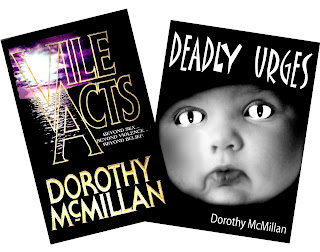
Interview with Dorothy McMillan, Author of Many Mysteries
Hi readers and writers,
I'm pleased to bring you an interview with someone who has published several books, and whose inventive mind enables her to create puzzling mysteries. Enjoy! Cheers Laura

How many books have you published to date?
Do you enjoy writing conferences? Any advice for newbies about going to writing conferences?
Tell us about your latest book.
Do you usually publish through the same publisher? Does that make an agent less necessary?
I'm pleased to bring you an interview with someone who has published several books, and whose inventive mind enables her to create puzzling mysteries. Enjoy! Cheers Laura


Dottie, how did you get interested in writing?
What kind of books do you most enjoy reading?I can’t remember a time when I didn’t love to write. When I was in the fourth grade, I wrote dozens of ghastly horror stories and sold them to the kids at school for a dime each. That was a lot of money way back then. Finally, irate parents told the principal, and I had to stop writing the stories, and give back all the money. My first rejection. But hardly my last. At least with my professional writing no one has asked me to give back the money.
Just about every kind. However, my favorite authors are Bradbury, Steven King, Ann Tyler, Mary Stewart, Mary Robert’s Reinhart, and Clive Cussler (who was in the same writing class as I was in college). An odd mixed bunch, aren’t they?
How many books have you published to date?
Are the books all similar or are there different series of them?To date, I’ve had seven books published. Two non-fiction: “Creative ways with Polymer clay” and “Artful ways with Polymer clay” under the name Dotty McMillan. And five novels under Dorothy McMillan. “Blackbird” “Soul Crossed” “Vile Acts” “Deadly Urges” and “The Devil’s Bell.” Two of these books were optioned for film, but, as usual in Hollywood, they never were filmed. But I got to keep the option money! Deadly Urges is now on the Kindle for a pittance. Fortunately, it’s getting some great reviews. I just wish I had more time to do some PR for it. Besides books, I’ve written five screenplays. Early on, I sold two of them. Again, they never got made. This is the toughest field of writing to try. I only do it because I enjoy the process and at times need a break from the novel writing.
All of the fiction books are in the same genre, that of Suspense Thrillers. I would love to venture out into other areas such as fantasy and sci-fi, but my agent doesn’t handle these. In the past he sold “Logan’s Run” but hasn’t handled that type since. Even so, I’m still working on a fantasy book during those days when I need to let the suspense thriller rest for a day or too.
How do you get the ideas for your books? Based on real experiences or your own great imagination or both?I love going to writing conferences, and I used to attend all kinds of them. I also taught at some of them. However, due to a variety of life things, I haven’t been able to do that much during the past few years. Nevertheless, they were extremely valuable in many ways. One of the best things about them is that they help to stimulate your creative nature, and can give you that push we all need, to make time to write, and keep at it. It’s also good to be with people who love the same thing that you do. Writers work alone so much, that getting out of the house and in contact with other writers is a healthy way to spend some time.For years, I went to every conference where Ray Bradbury was speaking as he had such a powerful message for writers. On one occasion, after a conference was over, he was walking in the same direction I was, and he noticed I had some papers in my hand. He asked if they were something I had written. I said yes. He asked if he could read some of it. In a state of total panic, I handed him the pages. He read all of them. Then he looked up at me and said, “Don’t you ever quit. You are going to make it!” At that time, I was actually ready to take up basket weaving instead of writing! We walked together to the corner of the street where Ray was to wait for his ride home. He has never learned to drive! I thanked him, hugged him, and as soon as his ride arrived, I made my way home in a daze. Those words of his stuck to me, as if crazy-glued, for the rest of my life. When my first book was published, I sent him a copy to say thank you for his encouragement. He wrote back and said he read it, his wife read it, and so did his daughters. He said it was fantastic! From that day on, we exchanged Christmas cards, our successes, and our failures. I’m not sure what I would be doing today, without his kindness and encouragement. Probably basket weaving.
I wish I didn’t have so dang many ideas for my novels. I have dozens of summaries, starts, and idea pages for future novels. They just pop into my head and won’t go away until I record the idea. It would take two lifetimes to write them all. They are always based on some facts. Then I go nuts from there and add all kinds of wild and dark things. In one book, a character in the book is actually a written description of my mother. Not what she looked like, but what she was like. A little skewed, a lot off kilter.
My non-fiction writing is always about the art of working with Polymer Clay, something I’ve done, and taught for about twenty years. Each of these books took a full year to write and photograph. Not as much fun as writing fiction and a lot more work. However, selling non-fiction is usually easier than selling novels. My agent handles more of that now, than fiction. It’s especially good if you are able to write about something, in which a lot of people are interested.
The novel I’m working on now is “The Gray-Green Underground.” Did you know that underneath Tokyo there is a large farm that grows all kinds of food crops? Did you know that in the U.S. there are old mines where all kinds of things are being grown underground? Did you know that many of these growing things have been bio-engineered and could be deadly to mankind. Surely there has to be a book I could write about all this, one filled with murder, mayhem, and madness.
A strange little hunchbacked man named Hagan Poole built a strange stone castle as his home over a hundred years ago. Today it still sits like a stone fortress in a wild little canyon in the San Gabriel Mountains of Southern California. Shadowed by dark stands of pines, it gives one a creepy skin prickling sensation on first sight. This is the setting for the book. A place like this actually did exist.
Through lonely years after Poole’s death, the hallways of his stone castle collected giant tangles of hoary spider webs. Slime-green fungus and powdery white mold oozed from the blushing Tutor brick that lined the enormous kitchen. The entire place reeked of a syrupy dampness and a putrefying mushroom smell. Abandoned and forlorn, the place languished silently. Forgotten.
Forgotten, that is, until twenty-eight year old Isabel Warren received the unexpected phone call from her dead husband.
There the story begins. There the terror and fear attack.Do you have an agent? How do you feel about agents? Are they necessary today?
A short time after Ray Bradbury encouraged me, my writing instructor at Orange Coast College gave a hard copy of my novel to Mike Hamilburg, an author’s agent who resides in Beverly Hills. Mike called me a few days later from the airport and said “I have your novel with me and I’m on the way to New York. I would like to represent you and try to shop it. Would that be okay?”When I was finally able to talk I said, “You bet!” So, off he went, and about four months later, he had it sold. That began a long and wonderful relationship, with one of the nicest, most honest, and helpful agents anyone could have. It was just one of those fantastic lucky things.Today, it is possible to sell a novel without an agent. But it is a lot better and easier if you can find one who will represent you, that is if you want to get a traditional paper book publisher. They will not represent a self-published writer unless it looks as if their book might take off and make a lot of money. Some of these do. Most do not.There is a huge list of authors agents online. They usually say what type of writing they represent. You can send a good query letter to all of them to see if they are interested in working with you.Publishing is in such a wild state today. No one knows how it will all turn out. Before now, I have always been against “self-publishing” because I’ve seen so many problems with doing it. So many friends ended up by paying for hundreds of their books which ended up in their garage, and no way to distribute or advertise them. However, this is changing. You don’t have to pay huge amounts to self-publish now, and can buy one or two of your books at a time. The major problem however, is getting out there and doing all sorts of things to publicize your book. All the things that a paper publisher does for its writers. It takes a great deal of time and effort.
Do you usually publish through the same publisher? Does that make an agent less necessary?
No, unfortunately, I’ve had different publishers. You wouldn’t believe the things that have happened with my work through the years. Way too many things to mention. But I would just say that if you are lucky you will sell to a publisher who won’t merge with another publisher, won’t go out of business, and who won’t give you an editor who says he doesn’t believe that a woman can write a successful suspense thriller, and the worst, a publisher who decides that Robin Cook’s new book should be the lead novel instead of your novel which was slated for that honor. All because Cook didn’t meet his deadline for the month before. Despite all this, however, my books have always sold extremely well, no matter what house published them. If you are lucky, as some of my writer friends have been, and have the same publisher for all your books, an agent is still very important. Mine not only works to get a book published, but also takes care of the contract to make sure you are not getting stiffed some way. One publisher demanded the movie rights in my contract. My agent made sure that didn’t happen. There are dozens of things that need careful perusing. An agent takes care of all that, and is well worth his percentage.
What else would you like to share with the blog readers?
First, I would like to remind them that you will never have time to write, you have to make time. It means giving up a lot of things you might rather do. If that makes you unhappy, then stop writing and do the things you’d rather do. If writing is your life, then realize that you will have to spend a lot of that life putting words together to create stories, articles, whatever it is you like to write.
Second, don’t spend hours and hours on the first few chapters of your book, trying to make them perfect before you move on. Just jump in and write the whole darn book. My routine is to write like crazy in afternoons and late nights. Then I clean that writing up some in the morning, and then write new chapters all afternoon and night again. One you hit that last page of your book, put it away for a week or so. Then, take it out and read, polish it, and make it the best you can. Then get it out there and sell it. Get an agent if possible. Or start out by putting it on the Kindle, IPod, etc. Who knows, it might just take off and make you a zillion dollars. I sure hope so!
Thursday, April 15, 2010
Most Important Books for Writers
e I've been following with interest a thread on the Twitter/blog of Nathan Bransford, an agent with a lot of interesting thoughts, about what ONE book does a writer need?
The replies veer off into writing books, of which Stephen King's has been recommended the most often. Personally, I like William Zinser's On Writing Well, and several others of his books, far better.
But Nathan himself said it was The Great Gatsby. I suppose nothing is more inspiring than a great novel you can return to year after year, seeing new layers of meaning each time. People who teach great literature have this experience, and writers can too if they reread great books every so often. Others suggested The Bible (diversity of plots and characters), The Complete Works of Shakespeare (same but also the writing), The Sun Also Rises, Of Mice and Men. I would consider Little Women, Mrs. Dalloway, Pride and Prejudice but probably would choose a book of Chekhov's short stories.
The replies veer off into writing books, of which Stephen King's has been recommended the most often. Personally, I like William Zinser's On Writing Well, and several others of his books, far better.
But Nathan himself said it was The Great Gatsby. I suppose nothing is more inspiring than a great novel you can return to year after year, seeing new layers of meaning each time. People who teach great literature have this experience, and writers can too if they reread great books every so often. Others suggested The Bible (diversity of plots and characters), The Complete Works of Shakespeare (same but also the writing), The Sun Also Rises, Of Mice and Men. I would consider Little Women, Mrs. Dalloway, Pride and Prejudice but probably would choose a book of Chekhov's short stories.
Anyone out there have a favorite to suggest?
Friday, January 22, 2010
Favorite Inspiring Quotations on Writing
I've been writing a novel in which one of the characters posts a quotation every week, and since she wants to be a writer, a lot are about writing. I have collected some inspiring quotations about writing, partly by following a thread on She Writes site. Here are a few of my favorites:
"Writing is the only thing that, when I do it, I don't feel I should be doing something else." by Gloria Steinem
"We write to taste life twice, in the moment and in retrospect." by Anaïs Nin
"I write entirely to find out what I'm thinking, what I'm looking at, what I see and what it means. What I want and what I fear." Joan Didion
"In my view, a writer is a writer because even when there is no hope, even when nothing you do shows any sign of promise, you keep writing anyway." Junot Diaz
"When I dare to be powerful - to use my strength in the service of my vision, then it becomes less and less important whether I am afraid." Audre Lorde
Do you have a favorite writer you'd like to quote on writing? Please post in the comments!
Tuesday, July 7, 2009
Interview with Deb Martinson


LH: Deb, how did you get interested in writing?
DM: Mrs. Garfield, my 9th grade teacher, wrote on my Eleanor Roosevelt term paper: “you already have style. You are a writer.” From birth I have been an avid avid reader. And from 9th grade till now, my writer self has evolved.
LH: What was your first success?
DM: Aside from Mrs. Garfield?
LH: LOL
DM: Well, I won an DAR essay writing award in 11th grade for an essay on the Cuban Missile Crises (first written for MR. Garfield’s history class—he gave me a B- on it.)
LH: Obviously lagging behind his wife in discerning talent!
LH: What kind of things do you most enjoy writing?
DM: Enjoy??? Well I love researching just about anything. And then, of course, I have to write about it. I’d sure like to try fiction and have 16 scenes written. But I don’t know about the rhythm and cadence of fiction—so I’ll have to learn.
LH: Do you have an agent? Tell us about your experiences with/without agents.
DM: Yes, I have an agent. Nat Sobel who is terrific and yet he’s made me cry (and I am not a weeper). I got Nat through connections and sheer luck. He is a first class editor and task master and a straight talker (hence the tears). I think some books require an agent to do anything with publishing. Academic presses don’t require an agent and are a whole different publishing experience. In University presses, editors don’t intrude much, nor do their marketers. But of course, writers can’t expect to make a dime in any event. And an agent expects to make lots of dimes. That’s the requirement. Nat likes me anyway, I think, though he sure hasn’t made much money off me!
LH: What are your thoughts about marketing? Do you have any great tips on how to do it well?
DM: No. I do have good advice. If you want your book marketed, hire someone on your own. Your presses’ marketers will do MINIMAL. I haven’t done this, and I regret it. Next time. . .
LH: If you could go back in time and start over, tell us one thing you have learned that would help you to succeed better/faster/with less struggle.
DM: I’d start earlier (had a whole family and other career first). But I really don’t regret starting late . . .success? It is all a crapshoot. Keep writing, trying to do better, experimenting, having fun with it. Expect struggle. Learn to cuss.
LH: Any other thoughts to share?
DM: “Worth the effort. “ I named a whole introduction that on my Hellman book—my agent had turned down flat my first intro and I had to start from scratch. I didn’t want to do it. I wanted Nora Ephron or Joan Didion to write the intro. Ha! I had to do it myself—and it was worth the effort.
LH: Thanks, Deb, I’m sure my blog readers will enjoy this one!
DM: Mrs. Garfield, my 9th grade teacher, wrote on my Eleanor Roosevelt term paper: “you already have style. You are a writer.” From birth I have been an avid avid reader. And from 9th grade till now, my writer self has evolved.
LH: What was your first success?
DM: Aside from Mrs. Garfield?
LH: LOL
DM: Well, I won an DAR essay writing award in 11th grade for an essay on the Cuban Missile Crises (first written for MR. Garfield’s history class—he gave me a B- on it.)
LH: Obviously lagging behind his wife in discerning talent!
LH: What kind of things do you most enjoy writing?
DM: Enjoy??? Well I love researching just about anything. And then, of course, I have to write about it. I’d sure like to try fiction and have 16 scenes written. But I don’t know about the rhythm and cadence of fiction—so I’ll have to learn.
LH: Do you have an agent? Tell us about your experiences with/without agents.
DM: Yes, I have an agent. Nat Sobel who is terrific and yet he’s made me cry (and I am not a weeper). I got Nat through connections and sheer luck. He is a first class editor and task master and a straight talker (hence the tears). I think some books require an agent to do anything with publishing. Academic presses don’t require an agent and are a whole different publishing experience. In University presses, editors don’t intrude much, nor do their marketers. But of course, writers can’t expect to make a dime in any event. And an agent expects to make lots of dimes. That’s the requirement. Nat likes me anyway, I think, though he sure hasn’t made much money off me!
LH: What are your thoughts about marketing? Do you have any great tips on how to do it well?
DM: No. I do have good advice. If you want your book marketed, hire someone on your own. Your presses’ marketers will do MINIMAL. I haven’t done this, and I regret it. Next time. . .
LH: If you could go back in time and start over, tell us one thing you have learned that would help you to succeed better/faster/with less struggle.
DM: I’d start earlier (had a whole family and other career first). But I really don’t regret starting late . . .success? It is all a crapshoot. Keep writing, trying to do better, experimenting, having fun with it. Expect struggle. Learn to cuss.
LH: Any other thoughts to share?
DM: “Worth the effort. “ I named a whole introduction that on my Hellman book—my agent had turned down flat my first intro and I had to start from scratch. I didn’t want to do it. I wanted Nora Ephron or Joan Didion to write the intro. Ha! I had to do it myself—and it was worth the effort.
LH: Thanks, Deb, I’m sure my blog readers will enjoy this one!
Friday, July 3, 2009
Interview with Jia-Rui Chong Cook

LH: How did you get interested in writing?
J-R C: I’ve always loved to read, so I think it was only natural to want to try writing. I wouldn’t say I love the process of writing, though. It’s often difficult and always humbling. But I am always delighted to have created something in my own words. I think I got interested in newspaper writing because of the adventure. To write the best story, you have to get out to the scene, and you often get to see things most civilians never see. You get to be curious and ask a lot of questions that would normally be considered nosy. Then you get to try to make sense out of it and tell it to your audience in the pithiest, most evocative way. I think deep curiosity about character and the unfolding events makes for really great writing. I am always turned off by writing that lacks an intimate knowledge of a subject or lacks a thorough thinking-through of what things mean.
LH: What was your first success?
J-R C: If you define first success as first bylined article in a major publication, I guess I’d say that happened in the summer of 1999, when I got an article on good vs. bad low-fat foods in U.S. News and World Report magazine. I just started as an intern at the magazine and an editor assigned me to work with another reporter on low-fat foods. That reporter was nonplussed, but said I could start making some calls. When I came back to her saying that some nutritionists I talked to said there were actually bad low-fat foods, she was impressed. She suggested I do my own article.
If we’re defining success as my first award, that would be the 2006 Evert Clark/Seth Payne Award from the National Association of Science Writers and National Press Foundation. (Link to announcement: http://www.nasw.org/mt-archives/2007/08/jiarui-chong-wins-evert-clarks.htm) It’s given once a year to science writers under 30. I won for four pieces – a story about Alaskan villagers on the lookout for bird flu (http://www.latimes.com/news/nationworld/nation/la-sci-kipnuk22oct22,0,4438376.story), a story about the impact of bird flu on badminton, a story about recovering a lost text of Archimedes (http://articles.latimes.com/2006/dec/26/science/sci-archimedes26), and a story about the emerging human health risks from climate change (http://articles.latimes.com/2007/feb/25/science/sci-disease25). I was really excited about winning this award. I had only really started writing stories for the LA Times’s science editor in 2005.
LH: What kind of things do you most enjoy writing?
J-R C: My favorite kind of writing is narrative non-fiction. I love watching things unfold in front of me. I love having enough time with a subject that I can put the things I see in context and highlight the most meaningful bits. I love being able to write authoritatively in my own words, find my own analogies to describe something. This kind of writing is most similar to documentary filmmaking. Here is an example of one of my recent favorites of this kind: http://articles.latimes.com/2009/mar/25/local/me-marines25
LH: Do you have an agent? Tell us about your experiences with/without agents.
J-R C: No, I don’t have an agent.
LH: What are your thoughts about marketing? Do you have any great tips on how to do it well?
J-R C: When I am doing “marketing,” I feel as if I’m doing it on behalf of the LA Times. I want people to read my stories, but also to browse the Times and hopefully stumble on another story that interests them. I’m excited that the internet has made connecting to a potential audience that much easier. I have a Facebook page, where I often post my stories and stories by my colleagues that I like. I also have a Twitter feed (@jahree) that I update at least daily. I try not to insert too much of my opinion in these places, but I do give people reading my Twitter/Facebook posts something a little extra. It might be a funny comment a researcher made to me that didn’t make it into the story.
I also try to accept speaking invitations, even if they require a significant amount of work outside of my regular job. For instance, Zocalo, a group that organizes public lectures around Los Angeles, asked me to curate and moderate a panel discussion on veterans’ health issues at the UCLA Hammer Museum. (Link: http://www.zocalopublicsquare.org/archives_2009.php?event_id=243). While the story that this panel was based on has not yet come out in the LA Times, I did have many people come up to me afterwards saying that they’re looking forward to the story.
LH: If you could go back in time and start over, tell us one thing you have learned that would help you to succeed better/faster/with less struggle.
J-R C: I love the clarifying power of writing. When I first started working at the LA Times in 2002, one of the best writers at the paper said that clear writing requires clear thinking. I’ve really come to believe that when troubled, confused thinking results in bad, confusing writing. It’s worth taking the time to step back and ask, “What’s really important here? How do these things fit together?” Of course, sometimes you don’t know that you have a gap in your thinking until you try to put words on paper and you get stuck. That’s good, though. Then you know what you’re missing.
LH: Any other thoughts to share?
J-R C: I think I’ve said enough!
Subscribe to:
Posts (Atom)


